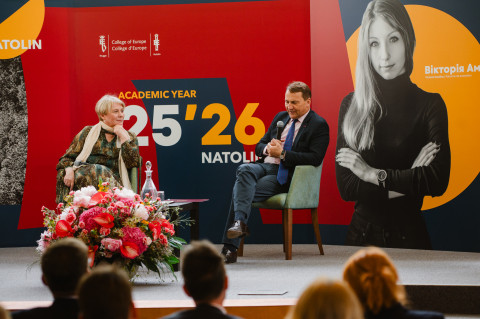
In this exclusive interview for the College of Europe, Professor Joel Trachtman shares his expert insights on international trade reform and the future of EU-US relations.
Could you describe the project(s) you are working on during your sabbatical?
During the past 2 years, I have been carrying out the Remaking Trade Project, which developed a report known as the Villars Framework to provide a roadmap toward utilizing the trade system to better promote sustainable development. The Villars Framework recommends many changes to existing international trade law but recognizes that these changes will be difficult to make. Therefore, it devotes a chapter to issues of governance and institutional reform, aimed at facilitating the necessary reforms by unblocking the process of treaty revision and decision-making. My project will extend that chapter, examining the legislative capacity of the international legal system in several areas beyond sustainable development, and studying the alternative institutional structures and techniques that may be suitable and available to permit more efficient and satisfactory rulemaking. My study will examine legal, economic, and political methods for determining suitability, and use a technique of comparative institutional analysis. One comparative reference will be the structure and techniques of rulemaking in the EU.
I am also concluding several other projects that have been in the works for a while, including the third edition of my book, Advanced Introduction to International Trade Law, a book that incorporates the learnings of the Villars Framework to be published late next year, and a book on international and comparative social media platform governance, to be published early next year.
Why did you decide to come to the College of Europe to do this?
My home institution, the Fletcher School of Law and Diplomacy, is a partner with the College in the MATA program, which I had a hand in structuring and initiating. I wanted to extend my knowledge of the College and its terrific faculty and students. Scholars at the College also have been helping me to understand some of the dynamics of governance in the EU, which as noted above is an important and very advanced comparative foil for my work on global governance.
What type of outputs do you hope to achieve?
The main output of my global governance project will be a book, but I may publish several of the chapters separately before the book is complete.
During your first full day in Bruges, you already participated in a panel in event on transatlantic relations during an election year. Did you note any differences in how this event went in Bruges versus how such an event might play out in the US? Were the themes and types of questions asked by the students similar, for example, or did they belie European biases/interests that would be distinct from that found in the US?
It was an excellent panel and very well attended, with very interesting and challenging questions from the floor. I found the students to be very well-informed about the issues. Of course, students from the US are generally familiar with US domestic politics and policy issues, but half of Fletcher students come from outside the US.
As an expert on international trade, what is your take on the future of multilateral trade in the current political climate that leans towards greater protectionism and development of industrial policy?
The multilateral trade system needs many reforms, as the Remaking Trade Project has revealed, and the reform efforts will not be led by the US any time soon. The EU is a leader in sustainability, and could be a leader in this field, but its unilateral actions such as CBAM and the Deforestation Regulation cause concern, especially among developing countries. Protectionism and industrial policy can hurt developing countries the most. Once electoral politics calm down, it would be good if the EU were to join with the US, perhaps with rebooted negotiations towards a Transatlantic Trade and Investment Partnership, that would allow them to work through some of the newly important trade issues, including sustainable development, security and especially cybersecurity issues, and e-commerce. The EU and the US could lead together.
If you could advise the incoming European Trade Commissioner on priorities for their term, what would it be?
Begin by engaging leading developing countries including but not limited to Brazil, India, China, and South Africa on revisions to CBAM and a more inclusive and responsive process for formulating outward-facing sustainability measures. Pay greater attention to moderating the trade distortions caused by industrial policy, especially in the sustainability field. If the focus is on global public goods, perhaps spend more of the funds in developing countries. This might be made more politically palatable by linking the spending to investment by European firms. Work with the US and other like-minded countries to develop a common approach to geoeconomic challenges in connection with chips, AI, and robotics, as well as critical minerals.
How would you advise the EU on trade relations with the US?
Once electoral politics calm down, it would be good if the EU were to seek to join with the US to drive trade and related sustainable development policy forward, perhaps with rebooted negotiations towards a Transatlantic Trade and Investment Partnership, that would allow them to work through some of the newly important trade issues, including sustainable development, security and especially cybersecurity issues, and e-commerce. The EU and the US could lead together, perhaps even partnering with one or more of the major developing countries to develop inclusive yet progressive positions.
 About the author
Joel P. TRACHTMAN is a professor of International Law at the Fletcher School of Law and Diplomacy, and holder of the Henry J. Braker Professorship of Commercial Law. He is also a visiting scholar for the Transatlantic Affairs Programme of the College of Europe.
Trachtman, a Harvard Law School graduate and former editor-in-chief of the Harvard International Law Journal, practiced in New York and Hong Kong for nine years before entering academia.
He has authored multiple books and served on the editorial boards of prominent journals, including the American Journal of International Law, the European Journal of International Law, and the Journal of International Economic Law.