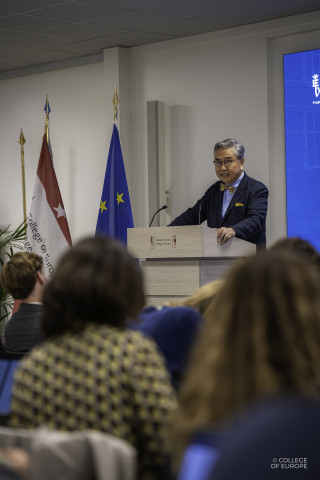
On 14 November 2024, the Chair of Transatlantic Trade and Economy of the College of Europe, in cooperation with Microsoft, gathered more than thirty stakeholders for an informal, private conversation dedicated to the consequences of the reelection of Donald Trump as President of the United States.
The event featured welcome remarks by Microsoft and introductory insights from College of Europe Rector Federica Mogherini, Dr. Ian O. Lesser, Chair in Transatlantic Trade and Economy, and Dr. Rosa Balfour, Director of Carnegie Europe.
A summary of remarks by Dr. Ian O. Lesser, Chair in Transatlantic Trade and Economy, prepared by Marie Ketterlin, Research Assistant at the College of Europe
There was nothing more intensely followed than this. Every stakeholder, especially ones with an Atlanticist fiber, has followed this election with great attention. The stakes were high.
Now, how can we decode the reelection of Donald Trump?
A laconic “it is what it is” would be the first answer that comes to mind. But this was no routine event: all the indicators suggest that this result is on a different scale, a different magnitude. Trump not only won the popular vote, but also the House and the Senate, while conservative Supreme Court Justices were already in the majority. Trump’s reelection is an extraordinary event, driven by political personality and an angry mood among the electorate.
Trump’s reelection is a sweeping result. However, it is not so surprising.
It’s, once again, the Economy
The Economy has undoubtedly been a crucial driver in this election. A sense of economic insecurity, right across American society, has developed over the last few years. In this context, voters of very diverse backgrounds prioritized their economic concerns. In his 8 November Financial Times article, Francis Fukuyama – who famously saw liberal democracy as the ‘end of history’ – has described the election as a revolt against neo-liberalism on the one hand, and political correctness on the other.
Can this sign of the times turn into a Zeitenwende? Many argue that the past few years highlight a growing popular revolt against the elite. I would add that this presidential campaign and its results go beyond this trend: it is also a civil war among the elites. As campaigning relies on generous donations, some of these financial elites found in the new MAGA campaign a platform to voice anti-establishment concerns. The rise of Elon Musk as a political actor offers a striking example, but it is hardly the only one.
Beyond MAGA Loyalty, What Unites?
The results have now been out for more than a week and, since then, there has been no end of news about nominations and appointments. Foreign policy appointments have led the way. It is a list of Trump loyalists, mixing well-known and outspoken MAGA supporters with less predictable figures. What are the likely common elements across this group?
At first glance, unilateralism seems to trump isolationism. More precisely, a hard stance on US-China relations is shared across the board (indeed this is one of the few areas where Republicans and Democrats seem to agree these days). Concerns over economic and technological competitiveness are one driver; military-strategic competition with Beijing is another.
There is no roadmap. This administration’s vision of international politics is likely to be resolutely transactional. Vice-President elect J.D. Vance clearly presented his trade-off vision weeks ago, as he explicitly linked the US commitment to NATO to European treatment of American companies. This sort of linkage is nothing new, at least as a matter of political context. But such an explicit linkage is notable, especially at a time of ongoing regulatory disputes and looming trade wars.
Will Brussels stay relevant?
European partners have confronted the challenge of de-coding and working with the Trump administration before. Eight years on, some practices will probably kick in again. But it could be much harder this time around. Brussels will now need to turn the page on four years of enthusiastic partnership with the Biden administration, which tended to see the European Union as a key interlocutor across a range of policy issues beyond trade. Most serious is the potential for the new Trump Administration to disrupt NATO at a time of war in Europe (although actual American withdrawal from the Alliance is unlikely).
Clearly, we are in a new world when it comes to transatlantic relations – and the need to understand dynamics on both sides of the Atlantic.

Ian O. LESSER
Ian O. Lesser is Vice President at the German Marshall Fund of the United States and a member of GMF’s executive leadership team. He serves as Executive Director of the Brussels office of GMF and leads GMF’s work on transatlantic relations looking “south,” including the Mediterranean, Turkey, and the wider Atlantic. He also holds the Chair in Transatlantic Trade and Economy at the College of Europe in Bruges.
His expertise includes U.S. foreign policy and European and Middle Eastern security affairs.
 Marie KETTERLIN
Marie Ketterlin is a Research Assistant to the MATA Chair in Transatlantic Trade and Economy, Transatlantic Affairs Programme, at the College of Europe in Bruges.
She holds a Master’s degree in International Relations with a focus on International Negotiations and Expertise from Sciences Po Strasbourg and a Bachelor’s degree in History and Political Science from Université Lumière Lyon 2. Her research interests include US foreign policy, transatlantic relations, diplomacy, international negotiations, and hybrid threats.