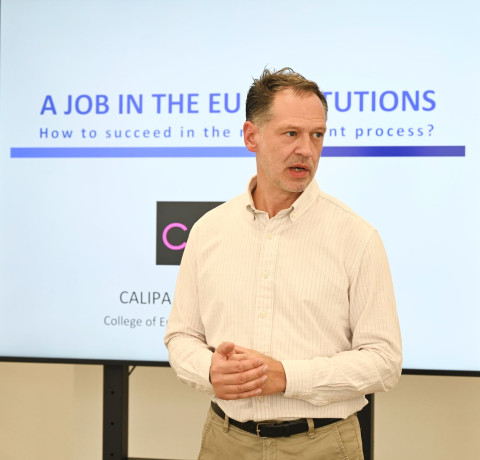
CoET prepares students for EU competitions
On 18 and 19 September, College of Europe in Tirana students took part in EPSO training led by Lieven Tack, founder of CALIPA Coaching and Visiting Professor in European Economics. Our students are...

In a packed room E in Dijver, an audience is listening spellbound to a panel of speakers. According to common stereotypes about the College of Europe, this scenario would typically occur when prominent political figures come to Bruges, as was recently the case of the Commission President, who delivered the keynote speech at this year’s opening ceremony. Cynics would claim that only career events, informing students about the EPSO competitions and potential entry points into the European institutions, could draw a similarly large crowd. On Thursday, the 14th of November, these assumptions were proven wrong: about 100 guests, primarily students from the Jacques Delors Promotion, were eagerly awaiting a roundtable entitled “Guide or Guise? How Theory Shapes European Integration.” Presumably, intellectual curiosity and a passion for academia led them there.
The event, organised by the Department of European and Political Governance Studies, and moderated by Michele Chang, Professor of Political Economy and Director of the Transatlantic Affairs Programme at the College of Europe, assembled five leading scholars of European integration: Sabine Saurugger (Sciences Po Grenoble), Michelle Egan (American University), Mark Pollack (Temple University), Uwe Puetter (Europa-Universität Flensburg) and Dermot Hodson (Loughborough University). The panel combined internal and external perspectives: While Saurugger, Puetter and Hodson have been Visiting Professors at the College of Europe for a long time, Egan and Pollack have studied the European Union, among other research interests, from the United States. The variety of topics and depth of the discussions not only left a lasting impression on the audience; it also induced the latter to actively engage with the speakers in an extensive Q&A-part.
One of the aspects discussed at length was the growing importance of critical analyses of European integration and demands for a decolonisation of the EU studies curriculum. Dermot Hodson argued that there was “huge room for pluralism” in the field and added that it would, for instance, “be madness to look at EU development policy without considering colonial histories.” Agreeing with Hodson on the necessity to consider European integration from multiple perspectives Mark Pollack explained that he incorporated critical approaches to EU studies in his contribution to the revised textbook “Policy-Making in the European Union“ (edited by Wallace et al.). Michelle Egan, drawing from one of her areas of expertise, added that the way scholars write about markets and trade was also at least implicitly biased by neo-colonial attitudes. She mentioned that the emphasis on exporting market rules, for instance, emblematic of Bradford’s hypothesised “Brussels effect,” fails to consider economic power and trade from the perspective of “recipient states” that are at times forced to adapt to EU preferences despite their detrimental consequences, particularly in environmental terms.
Picking up on Egan’s views on (lacking) equity and “asymmetrical forms of federalism,” Hodson made the point that fundamental rights in the EU, beyond the letter of the law, are not always equally applied to all EU citizens. He mentioned that a person of colour has a higher chance of being stopped by the police when crossing some borders. The EU needs to reflect more deeply on its motto - United in Diversity - Hodson argues in his book Circle of Stars: A History of the EU and the People Who Made It.
Asked by Michele Chang about the future trajectory of integration theories and, more specifically whether the “proliferation of new -isms,” often following empirical developments, has come to an end, the five experts agreed, to use Sabine Saurugger’s words, that “theory-building is ongoing as new questions still come up.” For instance, Uwe Puetter, who along Dermot Hodson was one of the main contributors to the theory of “new intergovernmentalism,” explained how the unexpected persistence of populism and “challenger governments” may have a profound impact on their assumption that intergovernmental negotiations are primarily consensus-driven. Asked by the audience whether populism is here to stay, Puetter, who taught at the Central European University in Hungary for 14 years, drew a pessimistic conclusion, based on his observation of a “long-term erosion of political culture that is no longer restricted to some Member States.” Mark Pollack added that the “constitutional division of power” is now more contested than ever. Clearly, Andrew Moravcsik’s prediction from 2005, according to which the EU had found a “stable constitutional compromise” had been proven wrong – not just by the failure of the Constitutional Treaty but, more importantly, subsequent developments, such as the increasing contestation of the primacy of EU law.
Building on the potential limitations of existing integration theories, Michele Chang asked the experts whether they should be complemented or even replaced by a mix of ideas from political science, international relations, or comparative politics. Mark Pollack replied that the scholars focusing on EU studies have so far “not melted into comparative politics or IR” and predicted that, in light of the EU’s sui generis nature, they will “never disperse into the general discipline.” Sabine Saurugger reinforced this assessment by arguing that the EU has not fully developed state qualities that would allow a comparative politics approach to take over, despite increasing politicisation of and participation in EU affairs and the emergence of complex issues, in which the EU potentially possesses a higher problem-solving capability than Member States.
At the same time, the experts argued in favour of more interaction between different disciplines. Michelle Egan pitched the idea that the post-functionalist GAL-TAN cleavage could be applied to the sphere of trade, whereby current calls for (open) strategic autonomy, de-risking and de-coupling would correspond to “traditional-authoritarian-nationalist” (TAN) attitudes. Green-alternative-libertarian (GAL) views on trade would prioritise deforestation, carbon neutrality, and corporate due diligence. Dermot Hodson expressed his admiration for scholars like Helen Wallace, who managed to “change away from integration theory and turn to mid-range theories, applying them so successfully.” Furthermore, he, like most panellists, argued that scholars have multi-faceted research interests, and similarly are not uni-dimensional in the theoretical frameworks they apply. For instance, he considers Ernst Haas not just as the proponent of neo-functionalism – a contestable theory, according to Hodson, – but rather as one of the first scholars to take institutions seriously, paving the way for the strains of political science that are now commonly subsumed under the term “new institutionalism.”
Finally, one student alluded to the title of the event to ask the very pertinent question of whether theory can shape integration or whether the relation is not inversed (theory merely explaining empirical developments). Dermot Hodson argued from his own experience working in the European Commission that even as a practitioner one is implicitly acting on theoretical premises, while potentially not being aware of this. Sabine Saurugger explained how the growing salience of the term “governance,” which emanated from the academic literature, in governmental practice demonstrates that scholarly ideas can exert a tangible influence. Mark Pollack added that “some theories are more appealing to practitioners than others,” citing Manner’s “Normative Power Europe” framework as a “flattering” and, hence, popular example. On the contrary, he recounted how the application of principal-agent-theory to the Commission prompted former President Barosso to make the remark “the Commission is nobody’s agent.”
After exchanging views for one and a half hours, two inferences can be made: First, theory and European integration are inextricably intertwined and continue to influence one another. Second, the European Political and Governance Department (POL) is more than a training ground for future officials and decision-makers. While it rightly prides itself on its success in the latter pursuit, the remarkable turnout of students and their active engagement with the expert panel unequivocally demonstrate that there is a lust for intellectual and academic debate, for which the College and the POL Department provide a fruitful ground.
 Leonard BRANDT
Leonard Brandt is an Academic Assistant at the European Political and Governance Department of the College of Europe in Bruges and a graduate of the Madeleine-Albright-Promotion (2023-2024). He also holds Master’s Degrees in Political Science from Freie Universität Berlin and in European Affairs from Sciences Po Paris. His research interests include political representation and the representativeness of EU institutions, populism and EU law, and morality politics.
On 18 and 19 September, College of Europe in Tirana students took part in EPSO training led by Lieven Tack, founder of CALIPA Coaching and Visiting Professor in European Economics. Our students are...