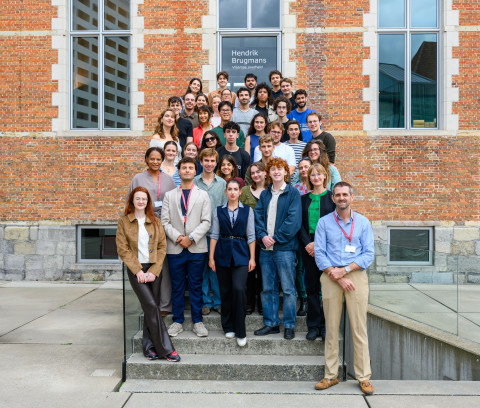
The Inter-Departmental European Avanced Studies Programme organised in 2022-2024 a conferences series aiming at investigating, discussing and documenting the impact of Covid-19 on the future of European societies. In line with the EG philosophy, it initiated an interdisciplinary dialogue with leading intellectuals on the future of European societies and potential changes currently occurring. Today, the global pandemic seems to represent a turning point that has been described as the “real new millennium”. The profound consequences of the pandemic, after a series of successive crises in the years 2000-2010, may represent a major turning point for European integration.
- Conference with Prof. Patrick PASTURE and Prof. Wolfram KAISER
Prof. Patrick PASTURE, a History professor at KU Leuven & Prof. Wolfram KAISER, Visiting professor at the College of Europe, analysed what can history can teach us about the current dynamics and potential future implications for European integration. The conference was entitled: “The empire that never was. A Global History perspective on European Integration"
2. Conference with Prof. Philippe POCHET and Marta SOLER
The conference fatured Prof. Philippe POCHET, author of A la recherche de l'Europe sociale and Prof. Marta SOLER. The conference was entitled “Is there a post-pandemic future for social Europe?”. The Professors gave an overview of the social Europe developments and discussed the impact of the covid-19 crisis on the approach of social policies. The discussion was moderated by Prof. Didier GEORGAKAKIS. A position paper was written by Professor POCHET to support the discussion.
3. Conference with Prof. Robert BOYER and Prof. George PAGOULATOS
Robert BOYER, economist and fellow at the Institut des Amériques (Paris) and author of Les capitalismes à l'épreuve de la pandémie (2020), will discuss with George PAGOULATOS, professor of the course "Crisis, Changes in European Political Economy and their Impact on Societies" and director of the Hellenic Foundation for European and Foreign Policy. The dicussion was moderated by Didier Georgakakis, Academic Coordinator of the European General Studies Programme. Prof. Boyer wrote a position paper which can be found here.
4. Conference with Rector MOGHERINI and Prof. Laurence BADEL
During this discussion, titled "Quiet Diplomacy and Plural Representation," Laurence Badel— author of Diplomaties européennes, XIXe–XXIe siècle (Presses de Sciences Po, 2021)— shed light on the long history of diplomacy in Europe and offered insights into its current state. Federica Mogherini shared her perspective as a high-level practitioner, drawing on her experience as former Italian Minister of Foreign Affairs and as High Representative and Vice-President of the European Commission.
Laurence Badel also published an article in Le Grand Continent in connection with the conference.
Laurence BADEL also published an article in Le Grand Continent linked to the conference.
5. Conference with Jonathan WHITE and Christopher BICKERTON
Jonathan WHITE, Professor of Politics at LSE, presented and discussed his work with Christopher BICKERTON, Professor of Modern European Politics at Cambridge University and visiting Professor at the College. They exchanged views on the following topic: "Emergency Europe: patterns and prospects". Jonathan WHITE presented the main results from his book “Politics of Last Resort: Governing by Emergency in the European Union” (2019), and reflected on what they entail in light of contemporary developments and the post-pandemic world. They addressed these issues tied to the politics of emergency, focusing specifically on the post pandemic era.
6. Conference with Juan DIEZ MEDRANO and Ruby GROPAS
Juan Diez Medrano presented the main results of his book "Europe in Love. Binational Couples and Cosmopolitan Society" published in 2020. Professor Ruby Gropas, visiting professor at the College is exchanging with him on what sociology can teach us about this type of relationships and what it can mean for the future of Europe and European integration.
7. Conference withTeresa Pullano and Nicole Dewandre
In a conference titled "Citizenship Without a State? European Citizenship in a 'Becoming-Territory'," Teresa Pullano and Nicole Dewandre examine the broader conditions under which elections are held and question the very concept of European citizenship. Teresa Pullano’s work focuses on the reconfiguration of European citizenship, which she sees as a unique form of state structure beyond the nation-state—particularly in relation to the reshaping of space and governmentality on a continental scale.
8. Conference with William Outhwaite, Luis Bouza and Alvaro Oleart
Professor William Outhwaite, from Newcastle University, presents his research on European identities, particularly from his recent book Transregional Europe. In this conference titled "Are We Europeans? Post-National Identities in Europe," he explores whether we can meaningfully speak of a European society—an essential question in understanding the relationship between European institutions and their citizens. His presentation was discussed by Luis Bouza, visiting professor at the College of Europe, and Alvaro Oleart, postdoctoral researcher at the Université Libre de Bruxelles.
9. Conference with Sandra Laugier and Margaux Cognard
Sandra Laugier, author of several books on TV series and their relationship to politics and society, participated in a conference titled "TV Series and Our Political Awakening: Towards Greater European Integration?" The discussion aimed to explore whether contemporary TV series act as drivers of politicization and mobilization, and more specifically, whether they contribute to shaping a shared European space.