Europe in the World through History
The European Civilization Chair at the College of Europe in Natolin provides students with opportunities to understand modern European history through broad and deep engagements with European civilization. Our work begins with the conviction that understanding Europe’s past in all of its complexity is not only an end unto itself but also essential to thinking clearly and creatively about Europe’s present and future.
Established in memory of the medieval historian, Polish statesman, and committed European, Professor Bronisław GEREMEK, the Chair continues his legacy by examining the cultures, institutions, and political forces that have shaped the idea of Europe over three millennia. From the pursuit of consensus among citizens in the Polish-Lithuanian Commonwealth to the ideological and geopolitical legacies of the Cold War, and from the Enlightenment to contemporary questions of memory, democracy, prosperity, and conflict, the Chair sustains scholarly conversations that are historically rigorous and civically engaged. We find continuing inspiration in the challenge thrown down to us all by the ancient Roman historian Sallust: 'it is better to live in perilous liberty than in tranquil servitude'.
Opportunities for Thought and Action

Through historical scholarship, the European Civilization Chair plays a central role in the intellectual formation of students pursuing a wide range of public vocations. Its courses provide students—many of whom go on to work in policy, diplomacy, and European and international institutions—with the tools to think causally across time, to dissect narratives and slogans sceptically, to critique world events judiciously, and to construct possible futures with increasing maturity.
Coursework, extracurricular activities, research, and events offered and facilitated by the Chair are all oriented toward thoughtful participation in the life of Europe and the wider world. Studying history at Natolin is an invitation to serious reflection and to 'slow thinking': to consider how cultures and institutions emerge and evolve, how ideas travel, cross-fertilize, and shape lives and dreams, and how political influences are remembered, challenged, or renewed.
Teaching and Curriculum
The Chair contributes to the academic programme at Natolin through compulsory foundational courses, specialist electives, masterclasses, compact seminars, simulation games, and workshops. These introduce students to decisive shifts and persistent continuities in the history of Central and Eastern Europe and to broader themes in European civilization, from republics, unions, and empires, through revolutions and cataclysms, to democracy and memory.
The Chair also coordinates the major in European History and Civilization, recruits distinguished visiting professors from leading international institutions, and fosters serious scholarly engagement through debates, thesis mentoring, and public events. We invite you to explore course options in the current Academic Year through our Teaching Activities page.
Research and Public Engagement
The resident professors of the Chair - Chairholder Richard BUTTERWICK-PAWLIKOWSKI, Georges MINK, Marek Aleksander CICHOCKI, and Slawomir DĘBSKI - are all active researchers and public intellectuals. Their published oeuvres span the history, culture, politics, and memory of Central and Eastern Europe from the sixteenth century to the present, and they contribute to scholarly and public debates in the European and Atlantic world. Further details can be found through our webpages describing our Team profiles, Research activities, and Selected publications.
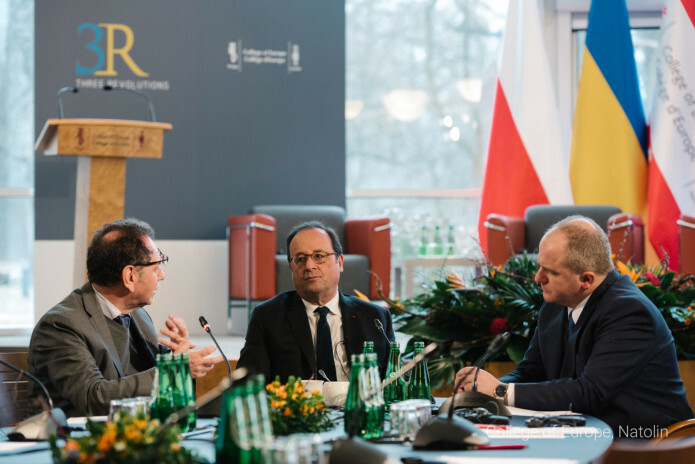
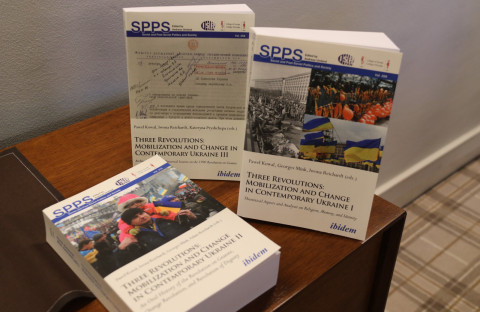
The Chair also hosts a unique electronic resource for scholars and students: the archive of the 3R Three Ukrainian Revolutions project, which makes available dozens of recordings, transcripts, and documents relating to participants and eyewitnesses of the dramatic events of recent Ukrainian history. Visit: www.3rnatolin.eu
At its core, the European Civilization Chair helps to cultivate habits of attention to evidence, to complexity, and to diversity that are essential both to reputable scholarship and to healthy civic life. The study of history offers depth, perspective, and the capacity to deliberate. We invite students from all disciplines to explore how dedicated engagement with Europe’s past can enrich thinking, sharpen judgment, and support student work—wherever it may lead.
Contact:
European Civilization Chair
College of Europe in Natolin
+48 22 54 59 480
Ul. Nowoursynowska 84
PL-02/797 Warsaw